You Have an AI Chronology... What Next?

November 2026 | Loveless Legal Nurse Consulting
You Have an AI Chronology... What Next?
5 clinical questions to ask before relying on an AI-generated report!
AI-generated chronologies can be incredibly useful.
They can organize large medical record sets, identify dates and diagnoses, summarize treatment, and help the legal team understand the basic timeline of a case more quickly.
That can be especially valuable in medical malpractice, wrongful death, and catastrophic injury cases where the record may span multiple facilities, specialties, procedures, and years of treatment.
But once the chronology is generated, there is another question to ask:
What next?
AI can summarize the record. A nurse understands the story.
A chronology can tell you what is documented. Clinical review helps determine whether the information fits together, what may be missing, and what deserves a closer look.
Before relying on an AI-generated report, consider these five questions.
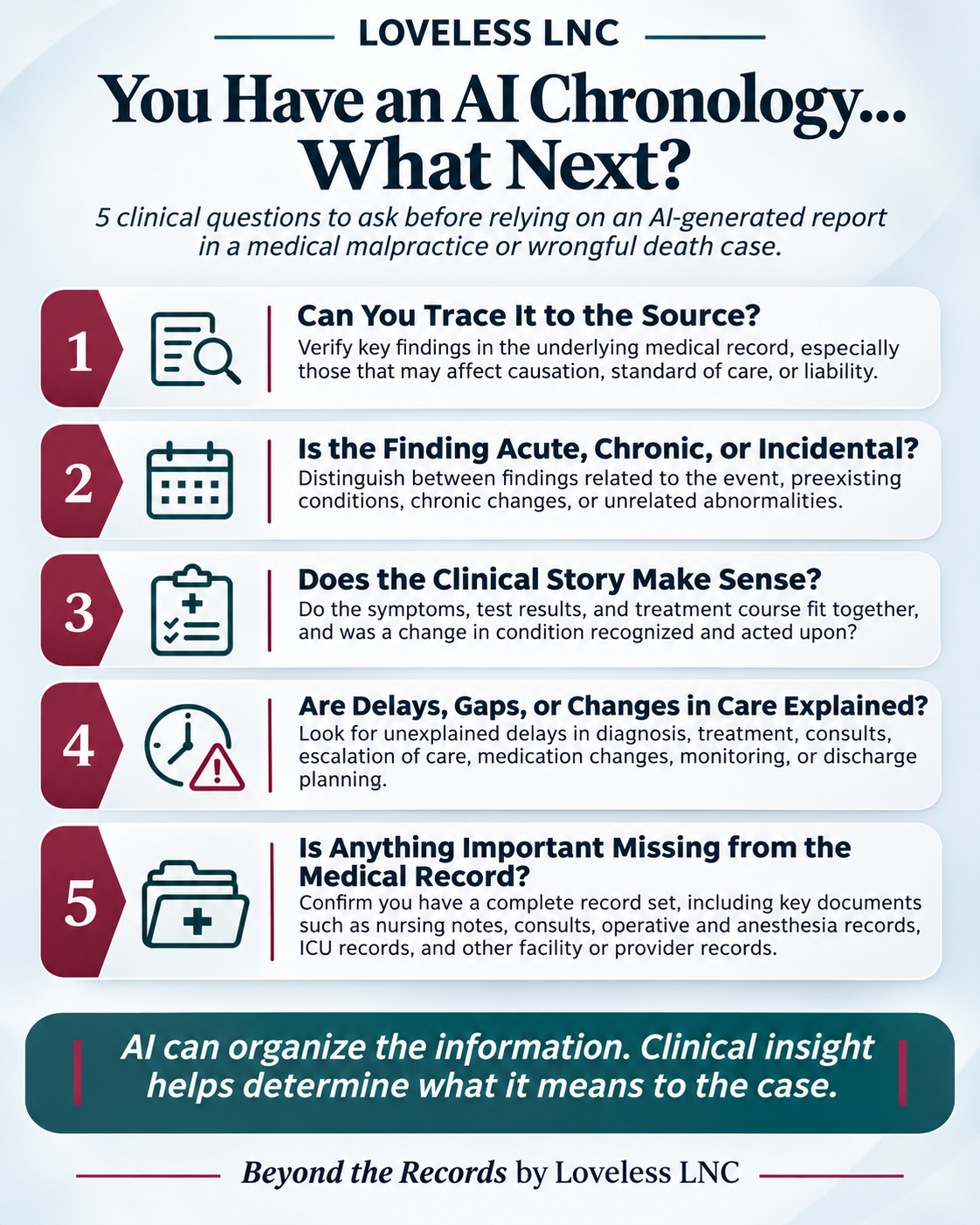
1. Can You Trace It to the Source?
Important findings should be easy to verify in the underlying medical record.
If a chronology identifies a diagnosis, imaging finding, medication change, procedure, deterioration in condition, or other significant clinical event, the legal team should be able to trace that information back to the original documentation.
This becomes especially important when the information may affect causation, standard of care, damages, or expert selection.
A useful chronology should make the source easier to find, not harder.
2. Is the Finding Acute, Chronic, or Incidental?
A finding can be accurately documented and still have little to do with the event at issue.
Imaging may identify chronic changes. A diagnosis may predate the event. A laboratory abnormality may be unrelated to the patient’s current condition.
The question is not only whether the finding exists.
What does it mean in the context of this case?
AI can find the detail. A nurse can explain why it matters.
3. Does the Clinical Story Make Sense?
A chronology may accurately list individual events and still fail to answer whether the medical story makes sense as a whole.
Do the symptoms fit the diagnosis?
Do the laboratory and imaging findings support the clinical picture?
Did the patient show signs of deterioration before a major event occurred?
Was a change in condition recognized and acted upon?
These questions can become particularly important in cases involving delayed diagnosis, failure to rescue, postoperative complications, medication errors, neurologic injury, infection, sepsis, or unexpected deterioration.
Sometimes the chronology gives you the sequence.
Clinical review helps you understand the story.
4. Are Delays, Gaps, or Changes in Care Explained?
In a medical malpractice or wrongful death case, timing can matter.
Was there a delay between an abnormal finding and the next intervention?
Was a consult recommended but not completed?
Did the patient deteriorate before escalation of care occurred?
Was there a change in medication, monitoring, level of care, or discharge planning that deserves closer review?
Dates alone do not always tell the full story.
Sometimes the explanation is elsewhere in the record. Sometimes the absence of an explanation is the finding that deserves attention.
5. Is Anything Important Missing From the Medical Record?
An AI-generated chronology can only work with the information provided.
Depending on the case, missing records may include nursing documentation, medication administration records, imaging, specialist consultations, operative or anesthesia records, ICU documentation, EMS records, or records from subsequent providers.
A missing document may contain the information needed to understand timing, communication, escalation of care, or a change in condition.
A missing piece of the record can change how the entire case is interpreted.
Medical Record Review Is Not One Size Fits All
The goal is not to choose between AI and clinical expertise. The goal is to use the right resources for the needs of the case.
Some attorneys prefer a traditional nurse-led review.
Others already have an AI-generated chronology or report and need clinical enhancement.
For more complex cases, combining AI and clinical review from the beginning may provide the most comprehensive approach.
Efficiency is valuable. Interpretation is essential.
Loveless LNC isn’t just a company that writes chronologies. We’re a clinical resource for the firm, virtually, in person, traditionally, and alongside emerging technology.
Before relying on an AI-generated report, ask the five questions above.
Sometimes the answers confirm what is already there.
Sometimes they reveal that the case needs a deeper clinical look.
AI can organize the information. Clinical insight helps determine what it means to the case.